

Conference on Images of Death
From Wednesday 02 June to Friday 04 June 2027
Blois, 41000
Image has a prominent place in people’s relationships with death, both as a testimony of loss and as an act of remembrance. At a time of celebration for the Bicentenary of the Photography (Sept 2026-Sept 2027), the conference will focus on the representations of the dead, funerals and burial sites. More broadly, this conference invites to explore the role of images in archaeological research into death. By ‘image’ we mean all types of representation of a subject: tangible or intangible, static or animated, in two or three dimensions, from a microscopic to a whole territory scale.
This topic will be explored through three themes : image that contains information for the research (Source Images), image produced as part of archaeological studies (Produced Images), and image conveyed by past societies to their contemporaries (Images Conveyed).
This year’s meeting echoes past Gaaf conferences that explored topics such as dead bodies, landscapes, new practices, funerals and remembrance, but also the Rendez-Vous about archaeomatics.
The aim is to build on the discussions already underway by focusing on representations.
Ethics committee :
The use of visual supports for the study of corpses and funerary practices of the past raises ethical issues. Respect due to individuals and to the representation of anthropobiological heritage, but also the importance of considering the impact of such images on the various audiences – including the scientific community themselves – lead to question ethical production, use and sharing of those images. To support this reflection, an ethics committee has been set up. This committee includes specialists in osteology, sociology, law and philosophy. Its mission, on an advisory and volunteering basis, is to provide feedback and advice to the authors as well as to the scientific committee.
The ethics committee may be consulted at any stage of the conference, from the pre-conference abstracts to the final publication, as well as for the presentations and the posters.
You can reach the Ethics committee at the following address : rencontre2027@gaaf-asso.fr.
The scientific presentations will be structured around three broad cross-cutting themes:
-
Theme 1 – Source Images: what iconography reveals
In 1983, Philippe Ariès stated “Death is an iconophile”. The representations of death, of the deceased and also of the places and mortuary practices are numerous in the iconography of the past. Whether it involves photography, video, engraving, drawing, painting or sculpted reliefs, today archaeologists have at their disposal multiple visual sources that support the discussion of the funerary subject in past societies. They also increase the quantity of materials that can be used to interpret and understand archaeological remains.
In two or three dimensions, the figurative or sculpted images are valuable evidence of the materiality of the funerary spaces (localisation and environment, layout, spatial evolution etc), the treatment of the dead (clothing, shroud, transport and burial of the deceased, etc) and also about the beliefs and the relationship with death (the famous Danse Macabre, Vanitas or postmortem photographs, for instance).
The papers related to this theme will focus both on the exploration of the image as source, regardless of its nature and the context in which it was produced (scientific, artistic, artisanal, medical, intimate or family, touristic etc). Papers will focus on clear examples of use and rediscovery of iconography, with a critical and methodological approach of the sources. They will show how past images are collected, gathered, analysed, evaluated and reworked to support mortuary archaeology research.
-
Theme 2 – Produced images: producing images to understand and communicate
This theme invites reflection on the use of images in the study of funerary practices.
Archaeological research produces a great range of images, aiming to document and preserve observations that cannot be replicated. They are also used as intermediary tools of research, accompanying processes of analyses and interpretations. They are finally used to convey knowledge and understanding to a wide and diverse audience. Through dialogue with other disciplines and following the methodological evolutions, the possibilities of visual representations are many; from two-dimensional representation to tridimensional modelling, from fixed imagery to dynamic visualisations, from microscopic to spatial analysis.
The presentations will focus on recording methods and imagery acquisition techniques used in fieldworks, from sketches to digital surveys (photogrammetry, 3D scans, etc.), with a perspective of data conservation, structuration and utilization. They may also focus on imagery used as tools for exploration and analyses that allow nonvisible elements to be revealed (LiDAR, XR imagery, RTI, microscopy, hyperspectral imagery etc) or to visualize complex phenomenon thanks to spatial analyses (GIS, spatial statistics, etc.). Finally, the presentations will address the central role of image in the shaping, interpretation and diffusion of scientific results. Whether it involves maps, statistical representations, graphic reconstructions or digital visualisations, those devices contribute to make the results of research intelligible for the scientific community and a diverse audience (students, elected officials, visitors etc).
The papers prioritizing innovating approaches or developing reflections on the production and use of images in the building and dissemination of knowledge about funerary practices will be particularly appreciated.
-
Theme 3 – Conveyed images: what we can learn from archaeological data
Conveyed images are those created contemporaneously by past societies. These images contribute to our understanding of people’s beliefs and perceptions of death. Separate pieces of archaeological evidence that initially appear immaterial or tangential, when gathered can create a clearer overall picture of a past culture’s beliefs and practices.
This theme proposes to show that death is not only a biological event; it is also a social and cultural one. Therefore, this theme will focus on the staging of funerals, whether ostentatious or discreet, as applied to all their components. Regarding the deceased, the papers will, for example, focus on the treatment and the display of the body (embalming, funerals, etc.) or on the worn or deposited artefacts (clothing, jewellery, worship objects, etc.), providing insight into ritual practice. At the scale of the tomb, the papers will explore both the internal and external architectures, discreet or monumental (atypical nature of the containers, ornaments of the superstructures, etc.), and the way the deceased were perceived by the living.
The presentations addressing the organisation of burial grounds, from the arrangement of the graves to the elements that structure the area (fitting out, boundaries etc) will find their spot in that theme.
Finally, papers pointing to a specific interest in the placing of the deceased into a specific space, whether in a natural or anthropogenic environment (phenomenon of co-visibility, connections between the worlds of the dead and the living, etc.) will also be welcome.
Additionally, all the reflections concerning the methods used to reconstruct the funerary practices and the paradigms guiding the researchers in that field are also welcome in this theme.
Deadline for call for papers: December 15, 2026
Organizing committee : Jean-Philippe Chimier (Inrap, UMR 7324 CITERES), Samuel Bédécarrats (Aix-Marseille Université, UMR 7268 ADES), Emilie Trébuchet (Inrap, UMR 7324 CITERES), Jérôme Livet (Inrap, UMR 5199 PACEA), Viviane Aubourg (DRAC Centre-Val de Loire, SRA, UMR 7324 CITERES)
Scientific committee : Viviane Aubourg (SRA Centre-Val de Loire, UMR 7324 CITERES), Amal Azzi (Université de Poitiers, UMR 7302 CESM), Samuel Bédécarrats (Aix-Marseille Université, UMR 7268 ADES), Raphaele Bertho (Université de Tours, EA 6301, InTRu), Antoine Cazin (La Fabrique de Patrimoines en Normandie), Jean-Philippe Chimier (Inrap, UMR 7324 CITERES), Alexis Corrochano (SRA Occitanie, UMR 5608 TRACES), Patrice Georges-Zimmerman (Inrap, UMR 5608 TRACES), Gaëlle Granier (CNRS, UMR 7268 ADES), Jérôme Livet (Inrap, UMR 5199 PACEA), Jules Masson Mourey (UMR 5608 TRACES), Haude Morvan (Université Bordeaux Montaigne, UMR 5607 Ausonius), Sophie Oudry (Inrap, UMR 7268 ADES), Stéphanie Sauget (Université de Tours, UR 6298 CETHIS), Emilie Trébuchet (Inrap, UMR 7324 CITERES), Nicolas Vanderesse (CNRS, UMR 5199 PACEA), Elodie Wermuth (Eveha, UMR 7268 ADES)
Ethics committee : Marie Cornu (CNRS, École normale supérieure Paris-Saclay), Mathilde Daumas (Université libre de Bruxelles, Laboratoire d’Anatomie Biomécanique et Organogenèse – LABO), Mathilde Lequin (CNRS, UMR 5199 PACEA), Valérie Souffron (université Paris 1 Panthéon-Sorbonne, UR 2483 CETCOPRA)
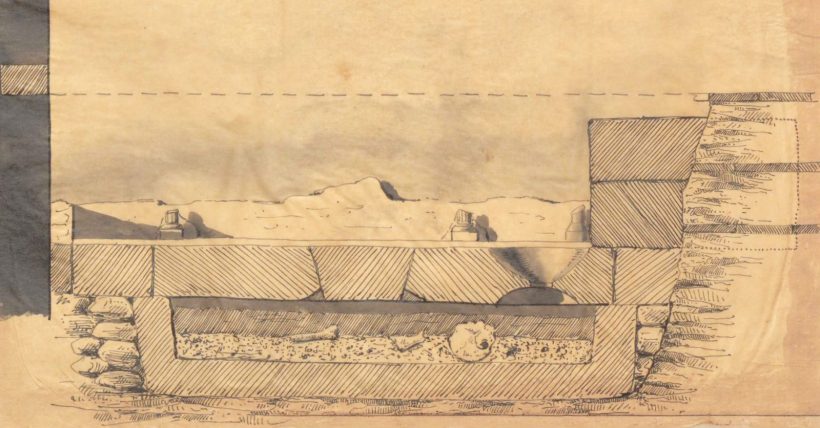
Photographic crédit : Anonym, Drawing from Église, ouverture du tombeau de Foulques Nerra: procès-verbal des fouilles (February 1870) – Departmental Archives of Indre-et-Loire (37), EDEP020/M11
Organisation contact :
- rencontre2027@gaaf-asso.fr
-
The conference will take place in Blois (Loir-et-Cher), at the University of Tours’ premises, at the IUT, Jaurès campus, next to the Halle aux Grains.